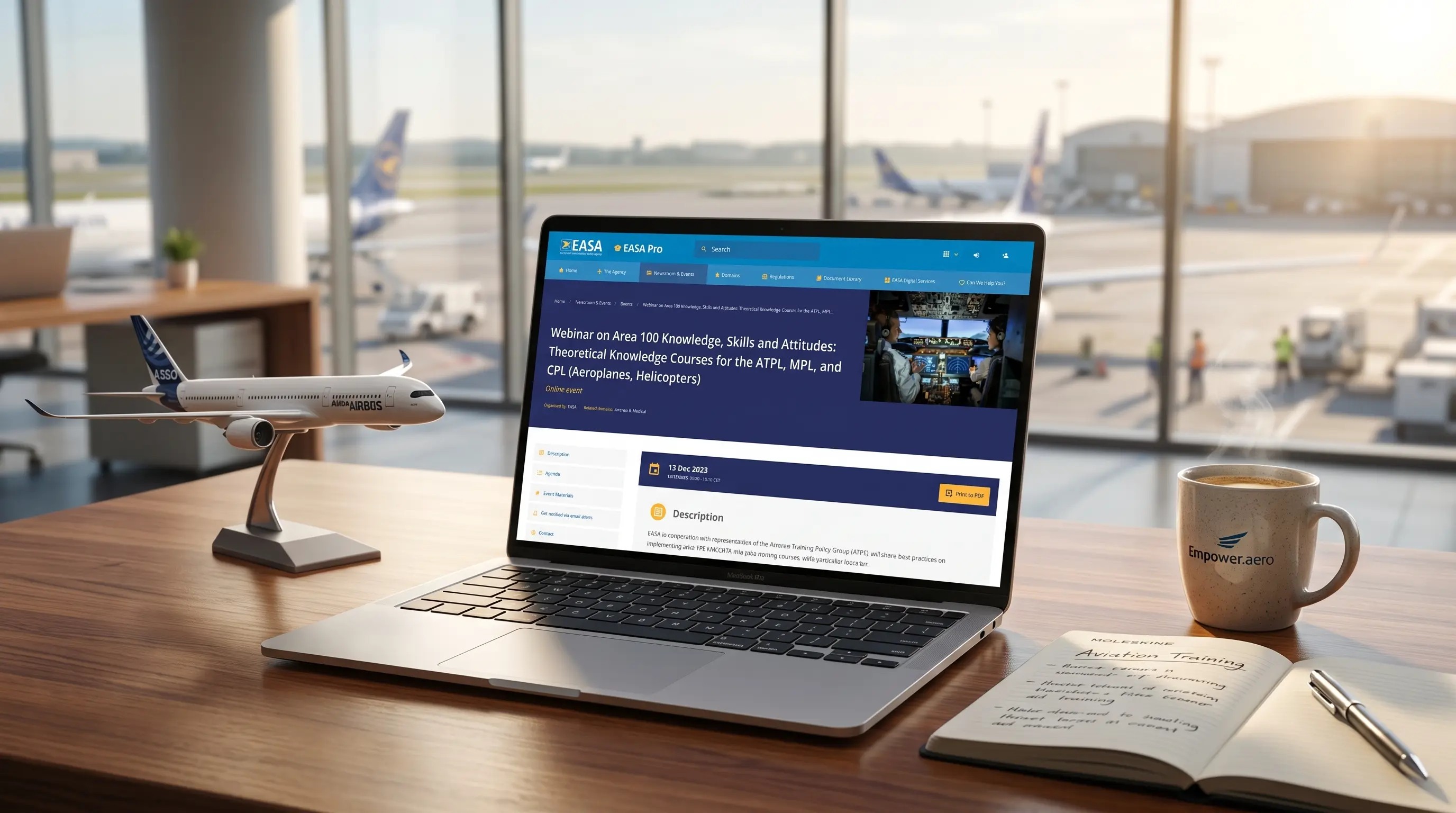
Europe — Shaping the regulatory conversation around pilot training standards requires direct engagement with the experts that helped draft the rulebook. We are proud to share that one of Empower.aero’s co-founders, Captain Andy Mitchell assisted in structuring the recent EASA KSA100 webinar event and delivered key presentations.
As the European Union Aviation Safety Agency (EASA) continues to refine and spearhead competency-based frameworks like the KSA100 pilot aptitude and knowledge assessments, industry stakeholders are looking for expert guidance on practical execution. Drawing upon decades of frontline regulatory and operational experience, our leadership stepped forward to help bridge the gap between policy and practice.
Bridging Regulatory Standards and Operational Reality
During the webinar sessions, Andy unpacked the intricacies of the KSA100 framework, providing attendees with a clear roadmap on how training organisations and operators can seamlessly integrate these standards into a wider competency-based philosophy without unnecessary administrative friction.
The presentations focused heavily on core principles that align directly with his experience gained in rolling out next-generation EBT and MPL architectures:
- Harmonising Assessment Criteria: Ensuring that KSA standards complement existing EBT and CBTA structures smoothly.
- Data-Driven Compliance: Utilising objective performance metrics to evaluate trainee progression transparently.
- Instructor Alignment: Preparing educators to evaluate human factors and core competencies with absolute concordance.
The response from the regulatory and operator community attending the webinar was overwhelmingly positive, with the webinar receiving a 100% satisfaction rate. This reinforces the industry's strong appetite for practical, field-tested expertise.
"Engaging directly with initiatives like EASA's KSA100 ensures that our clients are always ahead of the regulatory curve. We are committed to translating European mandates into clear, executable training paths."
We thank EASA for hosting such a vital platform for collaboration and look forward to continuing our active role in shaping the future of global aviation standards.